Alexander the Great and the Gordian Knot: Sword or Cleverness?
The tale of Alexander the Great and the Gordian Knot is one of history's most enduring legends, a powerful metaphor for problem-solving that has resonated through millennia. It's a story that asks us to consider whether the most complex dilemmas require intricate unraveling or a decisive, even radical, strike. This legendary encounter in the ancient city of Gordium poses a timeless question: did Alexander employ brute force with his sword, or was his solution a stroke of ingenious cleverness? To understand this pivotal moment, we must journey back to ancient Phrygia and uncover the knot's mysterious origins.
The Legend of the Gordian Knot: A Royal Prophecy
The story of the Gordian Knot begins not with Alexander, but with a humble Phrygian farmer named Gordius. According to ancient Greek tradition, the land of Phrygia, located in Asia Minor, found itself in a state of anarchy and unrest, lacking a stable form of government. Desperate for order, the Phrygians consulted the Oracle of Telmissus. The oracle delivered a clear prophecy: their next king would be the first man they encountered riding into the city of Gordium on an ox-cart.
True to the prophecy, the very next person to arrive was Gordius, a simple peasant. He was immediately hailed as king, fulfilling the oracle's decree and bringing peace to the troubled land. In gratitude and to commemorate this divine appointment, King Gordius dedicated his ox-cart to the god Jupiter (or Zeus, in some accounts), placing it in the temple. He then fastened the cart's yoke to its pole with an incredibly intricate knot, reportedly using the bark of a cornel tree. The knot was said to be so complex, with its ends completely hidden, that no one could discern how it began or ended. An additional prophecy soon emerged, declaring that
whoever could untie this Gordian Knot would become the ruler of all Asia. This weighty prediction transformed a simple dedication into a legendary challenge.
The Unsolvable Challenge: What Made the Gordian Knot So Formidable?
For centuries, the Gordian Knot stood as an insurmountable puzzle. Its reputation as "unsolvable" wasn't just folklore; it likely stemmed from its genuine physical complexity and perhaps even intentional design. Imagine a dense, tangled mass of rope, woven so tightly that its constituent parts seemed to merge into an impenetrable whole. The sheer difficulty was amplified by the prophetic stakes: untangling it promised dominion over an entire continent. This made the challenge not just a test of dexterity, but a trial of destiny itself.
Modern theories even suggest a scientific explanation for its intractable nature. Two knot-science researchers, one from Poland and another from Switzerland, put forth an intriguing hypothesis. They proposed that the rope used for the Gordian Knot might have been treated before its creation. Specifically, they suggest the rope was soaked in a liquid and then, after being tied to the cart's deichsel (pole) and yoke, rapidly dried in the blazing sun. This process could have caused the rope fibers to swell and interlock at various points within the knot, changing its strength and making it virtually impossible to loosen or untangle conventionally. Using computer programs, these researchers were able to reproduce an unresolvable knot that closely resembled the ancient descriptions, lending credence to the idea that the Gordian Knot was, in fact, genuinely unyielding. This perspective offers a fascinating answer to the question, "Gordischer Knoten Wer Löste Ihn?", by implying that perhaps, no one *could* have untied it in the traditional sense. To delve deeper into these fascinating theories, explore
Was the Gordian Knot Truly Unsolvable? New Theories Revealed.
Alexander's Moment: Sword or Subtle Skill?
By 333 BCE, Alexander the Great, at the head of his Macedonian army, swept through Asia Minor. Hearing the legend and the prophecy, he arrived in Gordium, drawn by the challenge. Standing before the mythical knot, Alexander faced a moment that would define his approach to seemingly impossible problems. The question of "Gordischer Knoten Wer Löste Ihn?" hung in the air, awaiting his answer.
Historical accounts, notably from Plutarch and Quintus Curtius Rufus, provide two primary versions of Alexander's famous solution:
1.
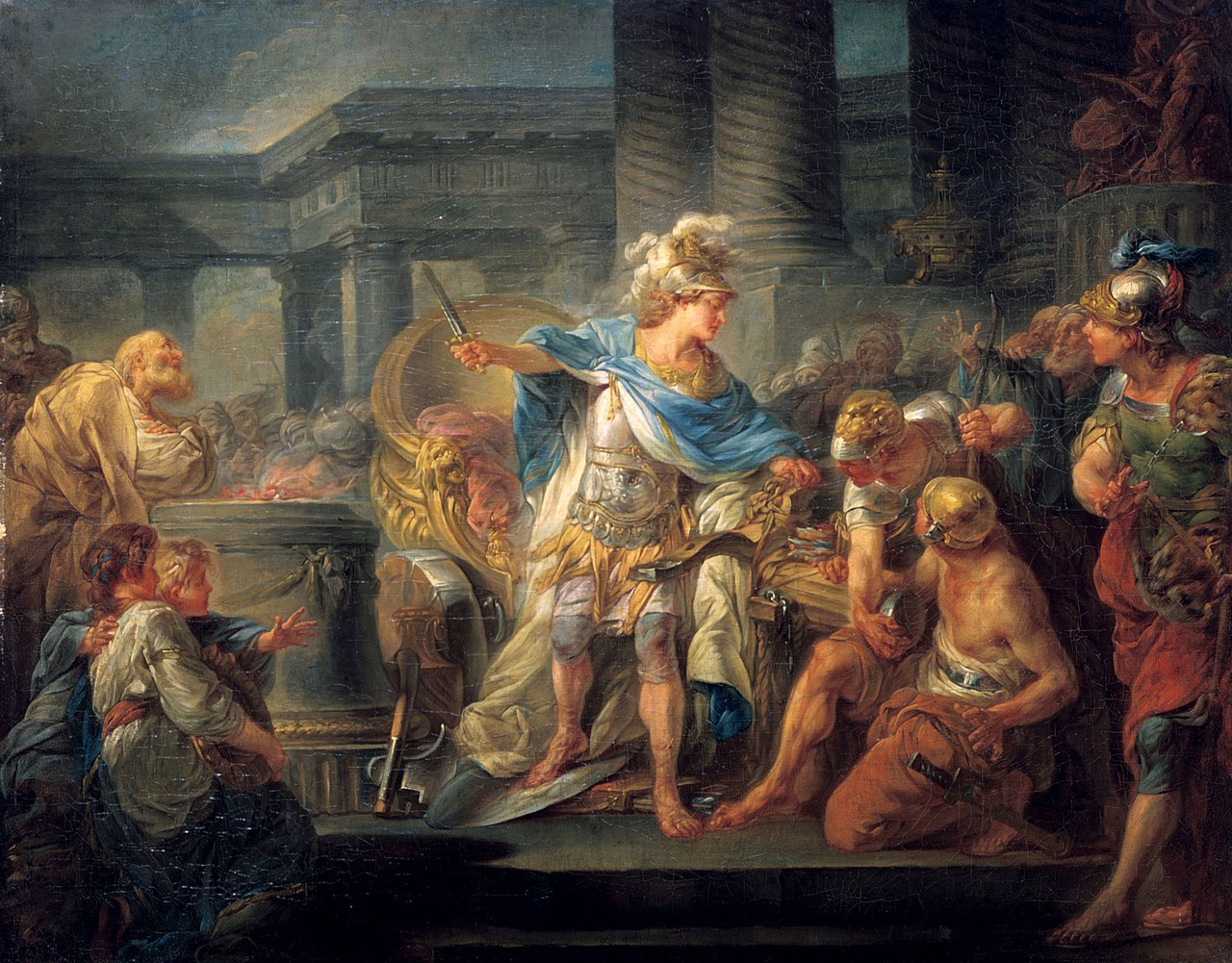
The Sword of Decisiveness: The most popular and widely accepted version recounts Alexander's frustration with the knot's intricacy. Rather than wasting time attempting to untangle it, he declared, "It makes no difference how it is loosed," or "I will loose it by cutting it." With a single, swift stroke of his sword, he sliced through the knot, effectively "solving" the problem through radical direct action. This bold act dramatically demonstrated his resolve and his rejection of conventional limitations. It wasn't about following the rules of knot-tying; it was about achieving the desired outcome – dissolving the knot and fulfilling the prophecy.
2.
The Clever Linchpin: An alternative, less sensational tradition suggests a more ingenious approach. According to this version, Alexander observed the knot more closely and realized that the key to unlocking it lay not in its intricate windings, but in the cart's construction itself. He reportedly pulled out the linchpin (or the *deichselnagel*, the nail securing the yoke to the pole) that held the entire apparatus together. By removing this crucial component, the yoke and pole separated, and the knot, no longer under tension or attached, simply fell apart. This intelligent solution bypassed the knot's complexity entirely, demonstrating a different kind of wisdom – identifying the core vulnerability of the system rather than directly attacking the problem as presented.
Both narratives portray Alexander as a man who approached challenges unconventionally. While the "sword" version is more dramatic and fits Alexander's image as a conqueror, the "cleverness" version highlights strategic thinking. Regardless of the exact method, Alexander's solution was deemed successful. Following this event, Alexander indeed embarked on his monumental conquests, extending his empire across Asia to India, fulfilling the prophecy and cementing his legacy as a brilliant leader who refused to be bound by perceived impossibilities.
Beyond the Legend: The Gordian Knot's Enduring Legacy
The phrase "to cut the Gordian Knot" has become a pervasive idiom in English and many other languages, including its German equivalent "den Gordischen Knoten zerschlagen." It symbolizes the act of resolving a complex, seemingly intractable problem with a single, bold, and decisive action, often by disregarding conventional approaches or rules. The story of Alexander and the Gordian Knot offers profound lessons that transcend its ancient origins:
*
Challenge Assumptions: Often, problems seem impossible because we confine ourselves to specific ways of thinking about them. Alexander's solution, whether by sword or linchpin, was revolutionary precisely because it didn't adhere to the assumed method of "untangling."
*
Decisive Action: In many situations, prolonged deliberation or incremental efforts can be less effective than a swift, definitive move. Alexander's immediate action prevented paralysis by analysis.
*
Reframe the Problem: Instead of focusing on *how* to untie the knot, Alexander focused on *what* was required (to "loose" it) and *why* (to fulfill the prophecy). This shift in perspective opened up new avenues for solutions.
*
Leadership and Vision: Great leaders often possess the vision and courage to implement unconventional solutions, even when they seem radical to others. Alexander's act, regardless of its precise nature, instilled confidence and demonstrated a willingness to forge his own path.
Practical Tips for Your Own Gordian Knots:
1.
Identify the "Real" Problem: Is the difficulty truly in the "knot" itself, or in the system around it?
2.
Don't Be Afraid to Be Radical: Sometimes, the most effective solution isn't the most elegant or conventional, but the one that gets the job done.
3.
Look for the "Linchpin": Can you find a crucial, often overlooked element that, if addressed, unravels the entire complexity?
4.
Consider the "Sword": If traditional methods are failing, are there any aspects of the problem that can be definitively cut away or bypassed to move forward?
5.
Embrace Clarity: Alexander's decision brought immediate clarity to a muddled situation. Strive for clear goals and direct actions.
In conclusion, "Gordischer Knoten Wer Löste Ihn?" is a question with a legendary answer. Alexander the Great’s encounter with the Gordian Knot remains a powerful symbol of bold leadership and unconventional problem-solving. Whether he wielded his sword with brutal efficiency or applied subtle cleverness, his action demonstrated that some problems require a complete break from traditional thought. His legacy reminds us that facing our own complex challenges might sometimes necessitate a decisive stroke, cutting through the entanglement rather than painstakingly unraveling every strand. It's a testament to the power of action and the will to conquer perceived impossibilities, inspiring generations to face their own "Gordian Knots" with courage and ingenuity.