The Gordian Knot: Unraveling Its Ancient Origin and Modern Meaning
The phrase "Gordian Knot" immediately conjures images of an intractable problem, a seemingly impossible entanglement that defies all conventional solutions. But what exactly was this legendary knot, and
Gordischer Knoten wer löste ihn? Its story is a fascinating blend of ancient prophecy, political intrigue, and a display of audacious leadership by one of history's most iconic figures: Alexander the Great. Far from being merely a historical anecdote, the tale of the Gordian Knot offers profound insights into problem-solving that resonate even today.
The Legend of the Gordian Knot: A Royal Prophecy and an Unbreakable Challenge
The origins of the Gordian Knot are deeply rooted in the ancient kingdom of Phrygia, a land in Asia Minor. According to Greek tradition, Phrygia was plagued by anarchy and unrest due to a lack of stable governance. Desperate for order, the Phrygians consulted an oracle, seeking guidance on how to end their turmoil. The oracle's answer was clear: "Choose a king." When pressed further on where to find this destined monarch, the oracle delivered a second prophecy: "Elect the man as king who you first meet on your way to the Temple of Jupiter, riding in an ox-cart."
As fate would have it, the very first person to appear on the road, riding a simple ox-cart, was a humble farmer named Gordius. He was promptly proclaimed king, bringing peace and stability to Phrygia. In gratitude for his unexpected rise to power, King Gordius dedicated his ox-cart to the god Jupiter (or Zeus, depending on the account) and placed it in the temple in his capital city, Gordium. The yoke of the cart was then fastened to its pole with an extraordinarily intricate and complex knot, so cunningly devised that its ends were hidden, making it appear impossible to untangle. This was the famous Gordian Knot.
The legend didn't end there. Another prophecy soon emerged, declaring that whoever could successfully untie this intricate knot would be destined to rule all of Asia. For centuries, the knot remained in the temple, an enduring challenge that no one could conquer, symbolizing an insurmountable obstacle and a test of divine favor.
Alexander the Great's Audacious Solution: Who Dared to Cut the Knot?
The stage was set for the arrival of a conqueror whose ambition knew no bounds. In 333 BCE, during his campaign to subdue the Persian Empire, Alexander the Great, at the height of his power and military prowess, arrived in the city of Gordium. He was undoubtedly aware of the prophecy surrounding the Gordian Knot and saw it as both a symbolic challenge and a crucial stepping stone towards fulfilling his imperial aspirations.
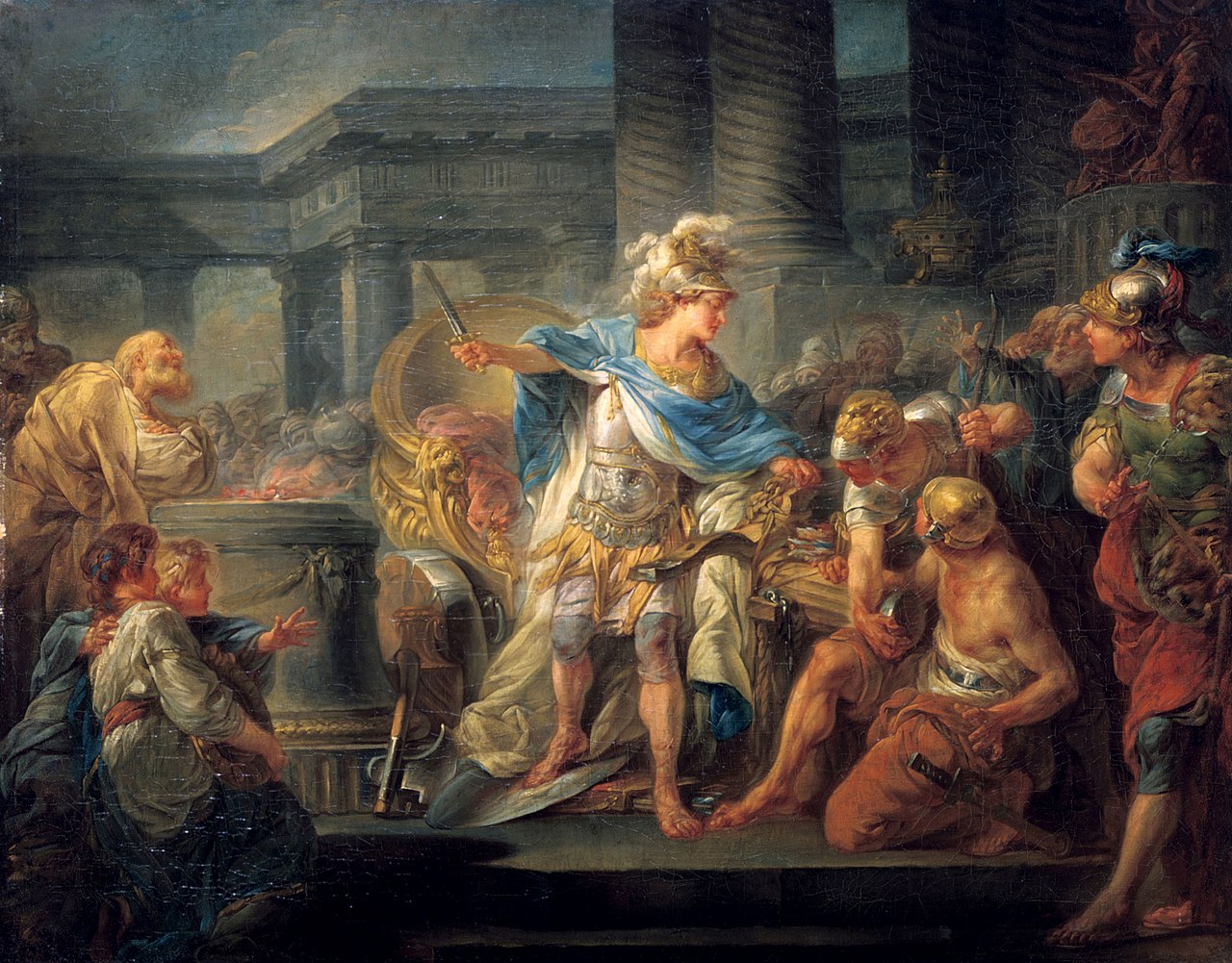
Confronted with the legendary knot, Alexander observed its intricate coils, the generations of failed attempts by others, and the weight of the prophecy. Rather than meticulously attempting to unravel it, a task that had stumped countless others, he opted for a dramatically different approach. According to the most widely recounted version, famously reported by historians like Plutarch and Quintus Curtius Rufus, Alexander drew his sword and, with a single, decisive stroke, sliced through the Gordian Knot. "It makes no difference how they are loosed," he reportedly declared, "only that they are loosed." By cutting the knot, he symbolically "solved" the problem, demonstrating a radical, direct, and unconventional method of addressing a seemingly unresolvable dilemma.
Indeed, Alexander's subsequent "worldwide" triumphal march through Asia, which took him all the way to India, seemed to confirm the prophecy, cementing his legacy as the man who dared to challenge the impossible. His act instantly became a powerful metaphor for addressing complex problems with audacious solutions.
However, an intriguing alternative tradition exists, suggesting Alexander's approach was less about brute force and more about cleverness. This version posits that he simply removed the linchpin that held the yoke to the pole, thereby dismantling the entire structure without cutting the rope. This "intelligent" solution would also have "loosened" the knot, fulfilling the prophecy through ingenuity rather than sheer power. Both versions highlight Alexander's unconventional thinking, but they offer distinct lessons in problem-solving. To delve deeper into this fascinating debate, you might explore
Alexander the Great and the Gordian Knot: Sword or Cleverness?.
Beyond the Blade: Theories on the Knot's True Nature and "Unsolvability"
The enduring mystery of the Gordian Knot isn't just *who* solved it, but *why* it was considered so incredibly difficult, if not impossible, to untie for centuries. Was it genuinely a feat of knot-tying genius, or did other factors contribute to its legendary status?
Modern scholars and "knot scientists" have put forth intriguing theories to explain the knot's legendary insolubility. Two researchers, one from Poland and one from Switzerland, proposed a compelling hypothesis. They suggest that the rope used for the Gordian Knot was likely soaked in a liquid *before* it was tied. After the intricate knot was formed, binding the yoke to the pole, it was then rapidly dried in the hot Phrygian sun. This process would have caused the natural fibers of the rope to swell and stiffen at various points within the knot, altering its strength and making its individual strands almost impossible to manipulate. The swelling would essentially "lock" the knot into place, turning what might have been a complex but solvable knot into an unyielding, rigid mass.
Using advanced computer programs, these researchers were able to reproduce a similar "unsolvable" entanglement, which they believe closely resembles the ancient original. Their work provides a plausible scientific explanation for the knot's reputation, suggesting that its difficulty might have been less about an impossible geometric puzzle and more about the physical properties of the materials and the environmental conditions. This fascinating research encourages us to look beyond simplistic explanations and consider the practical realities of ancient craftsmanship. For a more detailed look at these scientific explorations, check out
Was the Gordian Knot Truly Unsolvable? New Theories Revealed.
The Enduring Legacy: Modern Meaning and Practical Application
Today, the "Gordian Knot" has transcended its ancient origins to become a powerful idiom in our language. It refers to any exceedingly complicated, seemingly unresolvable problem, a deadlock, or a deeply entangled conflict. When we speak of "cutting the Gordian Knot," we invoke Alexander's legendary act, signifying a bold, decisive, and often unconventional approach to solve such a problem, rather than painstakingly attempting to unravel it through traditional, slower methods.
The metaphor is widely applicable across various domains:
- Business & Strategy: A company facing declining profits due to deeply entrenched inefficiencies might "cut the Gordian Knot" by undertaking a radical restructuring or divesting from underperforming assets, rather than trying incremental adjustments.
- Politics & Diplomacy: A long-standing international dispute with seemingly intractable positions could require a leader to "cut the Gordian Knot" by proposing an entirely new framework or a surprising compromise that bypasses traditional negotiation stalemates.
- Personal Development: Individuals struggling with a persistent bad habit or a complex personal dilemma might need to "cut the Gordian Knot" by making a drastic lifestyle change or seeking entirely new perspectives, instead of continually battling the symptoms.
Practical Tips for "Cutting Your Own Gordian Knots":
- Challenge Assumptions: The first step is to question why the problem is considered "unsolvable." Are there hidden assumptions or rules that are artificially limiting your options?
- Reframe the Problem: Sometimes, the difficulty lies in how we perceive the problem. Can it be rephrased or approached from a completely different angle?
- Identify the Core Issue: Often, complex problems are a tangled mess of symptoms. What is the fundamental root cause? Alexander didn't try to untie every strand; he addressed the core structure.
- Consider Radical Solutions: Don't be afraid to think outside the box. What would be the most direct, albeit unconventional, way to achieve the desired outcome?
- Be Decisive: Once a path is chosen, commit to it. Alexander's strength was his swift and confident action.
The lesson of the Gordian Knot isn't always about brute force; it's about the courage to defy convention and the ingenuity to find a path that others overlook. It reminds us that sometimes, the most elegant solution is not to meticulously untangle, but to redefine the problem or the rules of engagement altogether.
Conclusion
The tale of the Gordian Knot, from its humble origin with King Gordius and an ancient prophecy to Alexander the Great's decisive act, continues to captivate and instruct us. It offers more than just a historical account of
Gordischer Knoten wer löste ihn; it provides a timeless metaphor for confronting overwhelming challenges. Whether one believes Alexander used a sword or superior intellect, his legacy is one of boldness and ingenuity in the face of the seemingly impossible. The Gordian Knot serves as a powerful reminder that complex problems often demand innovative, direct, and sometimes unconventional solutions, urging us to challenge established norms and carve our own paths forward.