Was the Gordian Knot Truly Unsolvable? New Theories Revealed
The legend of the Gordian Knot has captivated minds for millennia, a tale woven into the fabric of history and myth. It's a story of an intricate puzzle, a prophetic destiny, and an audacious solution that famously bypassed conventional wisdom. For centuries, the narrative has largely centered on Alexander the Great’s decisive action, leaving us with the enduring idiom "cutting the Gordian Knot" to describe a radical solution to a complex problem. But was this legendary knot truly unsolvable by any other means? Or were its mysterious properties more profound than mere complexity? Recent theories suggest the knot's "unsolvable" nature might have been rooted in unexpected physical characteristics, prompting us to re-evaluate one of antiquity's most famous puzzles.
The Ancient Legend of the Gordian Knot: More Than Just a Knot
The story of the Gordian Knot begins not with a warrior king, but with a humble farmer. According to ancient Greek tradition, the region of Phrygia in Asia Minor was plagued by anarchy and political turmoil. Seeking an end to the chaos, the Phrygians consulted an oracle, who prophesied that their next king would be the first man they encountered entering the Temple of Zeus (or Jupiter) on an ox-cart. This man was Gordius, a simple peasant. True to the prophecy, he was proclaimed king, and in gratitude, he dedicated his ox-cart to the deity.
It was this very cart, or more specifically, the knot securing its yoke to the pole, that would become the stuff of legend. The knot itself was described as extraordinarily intricate, fashioned from cornel bark, with its ends cleverly concealed within the labyrinthine windings. An oracle foretold that whoever could untie this seemingly impossible knot would become the ruler of all Asia. This prophecy elevated the knot from a mere dedication to a potent symbol of destiny and power, a challenge that vexed countless hopefuls before the arrival of Alexander the Great. It wasn't just a knot; it was a test of will, intellect, and perhaps, divine favor. For generations, the question lingered: *Gordischer Knoten Wer Löste Ihn*? Who could possibly unravel this ancient enigma?
Alexander's Audacious Solution: Sword, Strategy, or Something Else?
By 333 BCE, the knot had stood for centuries, an unbroken challenge in the city of Gordium. Alexander the Great, on his relentless campaign of conquest, arrived in Phrygia, undoubtedly aware of the prophecy. He faced the famous knot, an object that had foiled all before him. The moment of truth arrived, and with it, multiple versions of what transpired.
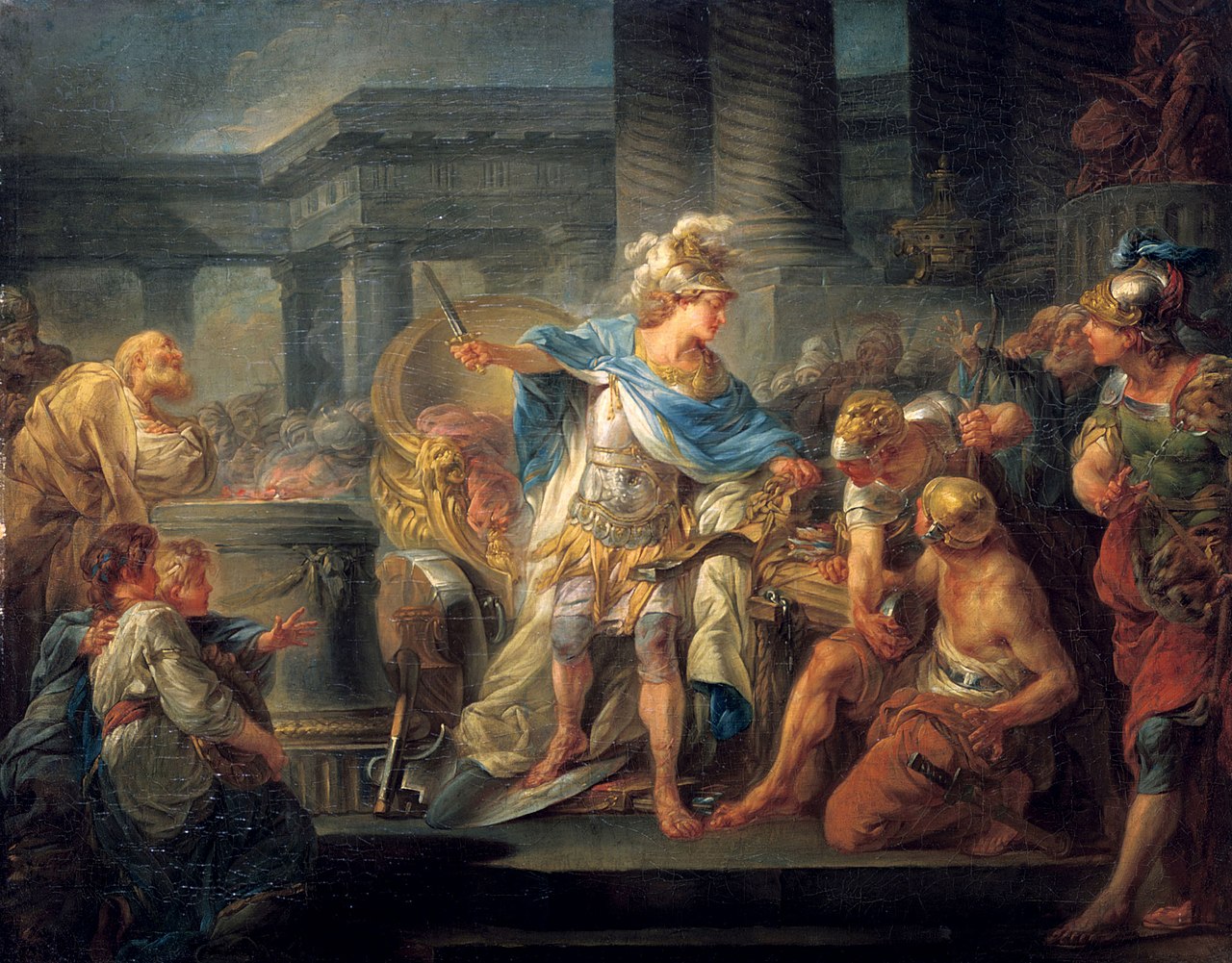
The most widely accepted and dramatic account, as reported by historians like Plutarch and Quintus Curtius Rufus, describes Alexander drawing his sword and, with a single, decisive stroke, severing the knot in two. This act was seen not just as a solution, but as a symbolic declaration: seemingly insurmountable problems sometimes require unconventional, even radical, action. Alexander didn't play by the rules; he redefined them. His subsequent "worldwide" conquests, stretching as far as India, seemed to confirm the oracle's prophecy and validate his audacious method. This swift, bold action indelibly linked his name to the knot and forever defined the phrase "cutting the Gordian Knot."
However, an alternative tradition offers a different perspective, suggesting Alexander's brilliance lay in cleverness rather than brute force. This version posits that instead of cutting the knot, Alexander observed its construction, noticed that the entire knot was fastened by a linchpin (or *Deichselnagel*), and simply removed it. By pulling out this pin, he would have effectively dismantled the underlying structure, allowing the seemingly complex knot to unravel. This "intelligent" solution suggests a strategic mind at work, demonstrating that not all challenges require destruction; some merely demand a deeper understanding of their underlying mechanics.
The debate over whether Alexander used a sword or employed cunning tactics highlights different approaches to problem-solving that remain relevant today. Both methods yielded the desired outcome – the knot was "solved," and Alexander marched on to fulfill his destiny. For a deeper dive into this fascinating debate, explore
Alexander the Great and the Gordian Knot: Sword or Cleverness?. Regardless of the exact method, the answer to *Gordischer Knoten Wer Löste Ihn* remains undeniably linked to Alexander the Great, whose actions transformed a local legend into a global metaphor.
Unraveling the 'Unsolvable': Modern Theories and Scientific Insights
While Alexander’s solution – be it by blade or by wit – provided a resolution, it still begs the question: was the Gordian Knot truly unsolvable by conventional untying? Ancient accounts emphasize its extraordinary complexity, making it appear as a puzzle beyond human dexterity. However, new theories, grounded in scientific investigation, offer a compelling explanation for why the knot might have defied all attempts to untie it, even by the most patient and skilled hands.
Two knot scientists, one from Poland and another from Switzerland, have put forward a fascinating hypothesis. They propose that the Gordian Knot's "unsolvable" nature wasn't merely due to its intricate weaving, but rather a deliberate, physical alteration of the rope itself. Their theory suggests that the rope, before being tied around the ox-cart's pole and yoke, was first soaked in a liquid. After the knot was intricately formed, it was then rapidly dried under the intense sun. This process, they argue, would have caused the rope fibers to swell and harden in various places within the knot, altering its strength and effectively "locking" the structure.
To test this theory, these researchers used a computer program to simulate and reproduce a knot that exhibited similar properties. Their digital reconstruction resulted in an "unsolvable" entanglement closely resembling the ancient original. This scientific perspective introduces a new layer of understanding to the legend. It suggests that the knot wasn't just intellectually challenging; it might have been *physically impossible* to untie without cutting or dismantling its core structure. This adds a compelling dimension to Alexander's action. If the knot was indeed physically fused, then cutting it wasn't just an audacious shortcut; it might have been the *only* practical way to "untie" it without damaging the cart itself, transforming his perceived impetuousness into a form of pragmatic genius.
The Gordian Knot Today: A Metaphor for Modern Challenges
Beyond its historical and scientific intrigue, the phrase "Gordian Knot" has transcended its ancient origins to become a powerful idiom in contemporary language. Today, it stands as a universal symbol for any complex, seemingly intractable problem or deeply entrenched conflict. Unlike a simple "knot that has burst" – a German idiom for losing patience – the Gordian Knot signifies a challenge that feels truly unmanageable, requiring significant effort, insight, or a paradigm shift to resolve.
In business, politics, and even personal dilemmas, we often encounter "Gordian Knots." These are situations where conventional approaches have failed, where various elements are so intertwined that disentangling them seems impossible. For instance, a long-standing geopolitical conflict, a deadlocked corporate merger, or an individual's struggle with deeply ingrained habits can all be described as Gordian Knots.
Understanding the legend offers valuable lessons for modern problem-solving. When faced with such a challenge, one might consider:
*
Analyzing the core structure: Is there a "linchpin" that, if removed, would unravel the entire issue, much like Alexander's rumored clever solution?
*
Questioning conventions: Are we constrained by traditional thinking, when a radical, outside-the-box approach might be necessary?
*
Decisiveness: Alexander's sword stroke, though perhaps a last resort, demonstrated the power of decisive action when analysis alone leads to paralysis.
*
Looking beyond the obvious: The new scientific theories remind us that problems can have hidden physical or structural properties that complicate conventional solutions.
Ultimately, "solving a Gordian Knot" often means daring to look beyond the surface, challenging assumptions, and sometimes, taking a bold, unconventional path. For more on the evolution of this timeless phrase, delve into
The Gordian Knot: Unraveling Its Ancient Origin and Modern Meaning.
Conclusion
The legend of the Gordian Knot is far more than a simple anecdote from antiquity. It’s a rich tapestry of prophecy, ambition, and ingenuity, perpetually challenging our understanding of what constitutes a "solution." From King Gordius’s humble origins to Alexander the Great’s transformative act, and now to modern scientific theories proposing a physical explanation for its insolubility, the knot continues to fascinate. Whether it was a marvel of intricate design, a clever mechanism with a hidden flaw, or a rope made literally untieable by ancient techniques, the enduring question of *Gordischer Knoten Wer Löste Ihn* has multiple layers of answers. Its legacy as a powerful metaphor reminds us that the most daunting challenges often require not just perseverance, but also the courage to think differently, to examine the problem from all angles, and, when necessary, to cut through the complexity with decisive, innovative action.